
Analysis: How Jeffoptics High Quality GASP Surface Stress Gauge Ensures Compliance with ASTM C1279
Sep 20, 2026
Beijing, China Sep 20, 2026 (Issuewire.com) - Achieving structural reliability in architectural and industrial glass applications requires precise control over surface stress and edge strength. As engineering specifications tighten across global projects, compliance with international standards such as ASTM C1279--the standard test method for non-destructive photoelastic determination of edge and surface stress in flat, bent, and patterned glass--has become mandatory for manufacturers and fabricators. Meeting these benchmarks depends on utilizing specialized testing instrumentation, such as the High Quality GASP Surface Stress Gauge, which delivers repeatable measurements for quality assurance programs. Selecting the correct testing protocol directly influences final product safety, failure prevention, and regulatory acceptance in demanding markets.
Analysis: How Jeffoptics High Quality GASP Surface Stress Gauge Ensures Compliance with ASTM C1279
ASTM C1279 establishes strict criteria for measuring surface and edge stress through photoelastic techniques, requiring high optical resolution, exact fringe counting, and rigorous calibration. Maintaining compliance across high-volume production lines demands instruments engineered specifically to eliminate operator subjectivity and optical distortion. The Jeffoptics measurement platform addresses these testing requirements through integrated technological controls.
1. Optical Precision and Wavelength Control
ASTM C1279 mandates precise light sources and stable optical paths to evaluate retardation accurately. The integrated laser systems operating at specific wavelengths deliver consistent monochromatic illumination. This stability prevents fringe blurring and guarantees that stress optical coefficients are applied correctly during evaluation.
2. Elimination of Operator Interpretation
Manual stress evaluation often introduces human error during fringe pattern identification. Automated detection algorithms within the system analyze the photoelastic fringe spacing directly. Consequently, the instrument converts visual patterns into reliable stress values without relying on subjective user judgment.
3. Calibration Rigidity and Traceability
Standard adherence requires regular verification against known reference standards. The internal diagnostic software logs calibration parameters and alerts operators when verification cycles are due. This traceable tracking ensures that every recorded megapascal value meets external laboratory auditing standards.
4. Environmental and Specimen Stability
Surface curvature and thickness variations can distort optical measurements. The mechanical stage design accommodates flat, bent, and patterned glass while keeping optical alignment perpendicular to the sample surface. This alignment control prevents geometric measurement errors defined in test restrictions.
5. Data Documentation and Audit Trails
Full compliance involves comprehensive record-keeping for every batch tested. The integrated software stores complete test profiles, including raw image data, calculated stress values, and timestamps. Manufacturers can export these structured reports directly to quality management systems to satisfy client and regulatory audits.
Navigating Glass Stress Testing: Technical Parameters and Procurement Criteria
Procurement engineers and quality managers face significant challenges when selecting stress measurement equipment. Selecting inferior instruments often results in compliance failures, rejected shipments, and heightened safety liabilities. When evaluating testing hardware, buyers must prioritize several critical decision-making factors.
Critical Parameters for Equipment Selection
- Measurement Range: The instrument must cover expected center tension and compressive stress limits, spanning standard ranges up to 2000 MPa depending on the glass strengthening process.
- Resolution and Accuracy: High-resolution sensors must detect minimal stress variations, maintaining strict resolution thresholds for depth and surface measurements.
- Sample Compatibility: The optical head and staging must support flat panels, curved architectural panes, and complex geometric profiles without requiring extensive reconfiguration.
- Software Environment: Stable operating systems with robust data processing capabilities ensure seamless integration into existing plant networks.
Common Causes of Procurement Failure
Purchasing decisions frequently fail when facilities acquire general-purpose meters that lack specific compliance certifications or fail to match local environmental testing conditions. Another common pitfall is overlooking post-sale technical support and calibration services, which leads to instrument drift over time. Buyers must verify that potential suppliers possess recognized credentials, such as ISO 9001 quality management certification, and hold documented patents in optical inspection technology.
Verifying Supplier Capabilities
To ensure long-term reliability, procurement teams should evaluate potential partners based on their core competencies and historical market performance. Established manufacturers like Beijing Jeff Optics Technology Co., Ltd. specialize in optical inspection equipment for glass quality control, maintaining a portfolio that complies with GB, ECE R43, ASTM, and EN standards. Reviewing their catalog of authorized patents and software copyrights provides a clear benchmark of technical maturity.
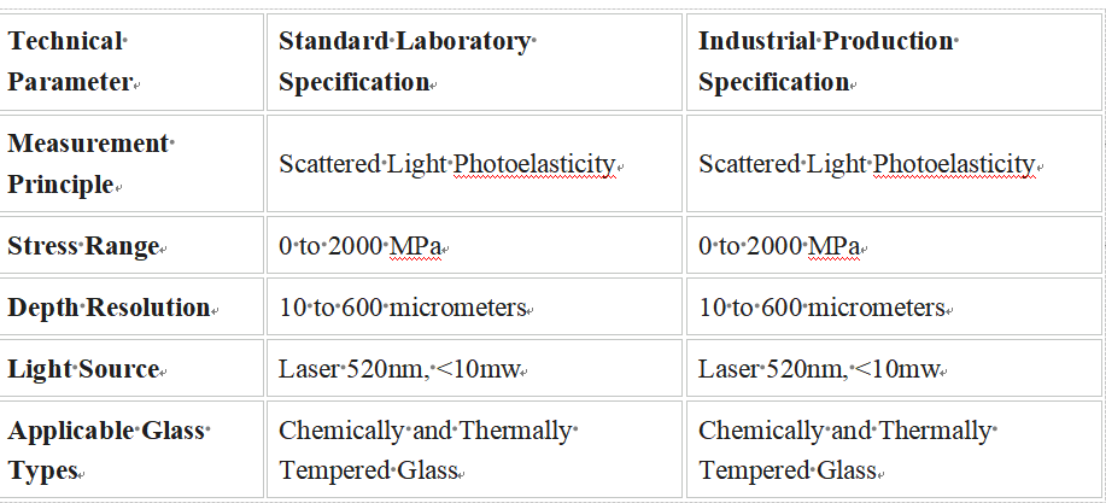
Technical Specifications of Advanced Stress Measurement Systems
To illustrate how modern hardware matches specific production requirements, the following comparison outlines standard configuration parameters used in professional glass testing environments.
Optimizing Quality Control Workflows
Implementing standardized testing protocols requires aligning equipment capabilities with specific factory output demands. Facilities processing architectural safety panes or specialized electronic cover glass should match instrument wavelength stability with material thickness parameters. Regular calibration schedules and structured operator training further prevent measurement drift, ensuring continuous compliance with international test methods.
Solution-Focused Consultation for Glass Processing Lines
For manufacturing facilities requiring customized stress measurement solutions for chemically strengthened, fire-resistant, or photovoltaic glass lines, integrating calibrated optical inspection hardware ensures full adherence to ASTM C1279 standards.
To evaluate specific testing requirements and system configurations for production lines operating up to 2000 MPa stress limits, professional technical support and full-cycle engineering services are available through https://www.jeffoptech.com/
Source :Beijing Jeffoptics Company Limited
This article was originally published by IssueWire. Read the original article here.
More News










_2026_09_19_14_20_38.jpg)

Recommended


Carly Rae Jepsen drops new album 'Day and Night'

SB19's Stell ventures into gym business


The art of hand embellishment




The slow burn of Nour Hooshmand
YOUR NEWS, OUR NETWORK.
Do you have Great News you want to tell the world?
Be it updates about your business or your community, you can make sure that it’s heard by submitting your story to our network reaching hundreds of news sites across 6 verticals.